Results
Summary
| Evaluation | Precision | Recall | FPR | Recovery / retained positives |
|---|---|---|---|---|
| Baseline BLS-only proposals | 0.130 | 1.000 | 1.000 | 15/36 (41.67%) |
| Baseline feature RF | 0.632 | 0.800 | 0.070 | 12/36 (33.33%) |
| Scaled BLS top-five search | — | — | — | 227/434 (52.30%) |
| RF v2 review point | 0.412 | 0.903 | 0.146 | 205/227 candidate positives retained |
The RF v2 FPR is derived from 292 false passes among 2,000 negative peaks. Its threshold is an exploratory manual-review operating point, not a calibrated planet probability.
The RF v2 denominator of 227 is the BLS-recovered positive candidate set, not all 434 eligible planets. Candidate-level recall and end-to-end planet recovery are different metrics and must not be compared as if their denominators match.
Baseline interpretation
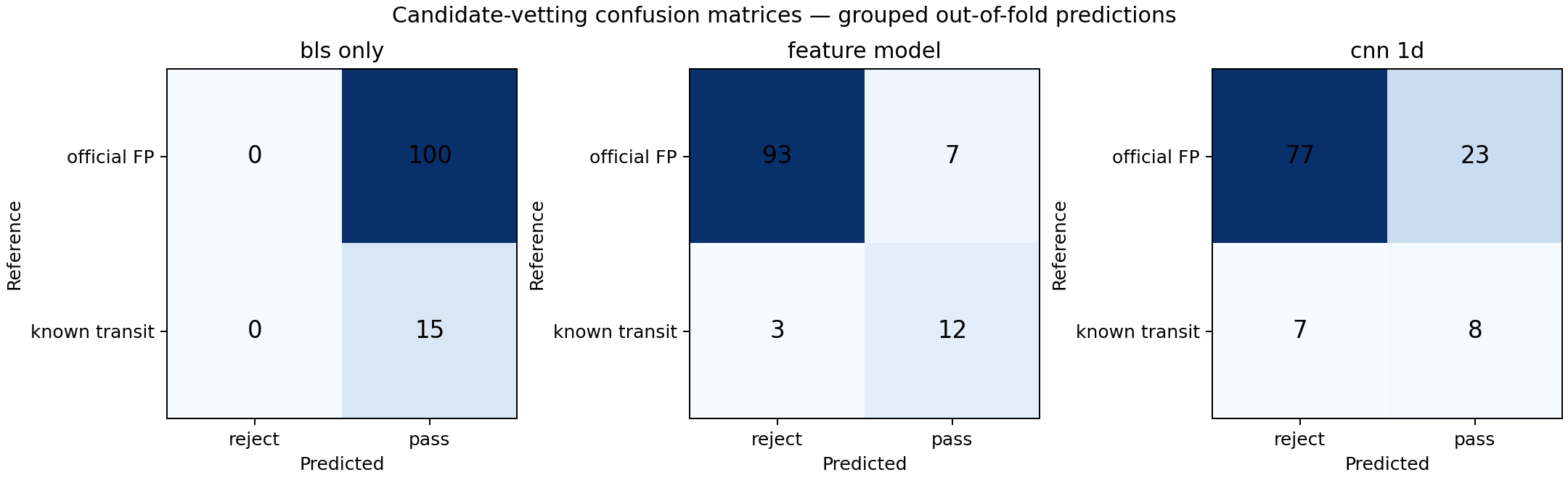
BLS recovers 15 of 36 eligible planets. The feature RF retains 12 of those 15 positive peaks and rejects 93 of 100 negative-system peaks. The improved candidate purity costs three recovered positive peaks; no downstream ranker can recover a planet that BLS did not propose.
Scaled recovery and model selection
With matched four-product coverage, BLS recovers 227 of 434 eligible planets (52.30%). RF v2 reaches precision 0.412 and recall 0.903 at threshold 0.221107. The CNN reaches recall 0.912 at threshold 0.394803 but precision 0.198 and fold-F1 standard deviation 0.166, so it remains secondary under the frozen selection policy.
Candidate search
The 250-target search produces 1,250 peaks and a 20-signal queue. A live post-ranking catalog recheck finds no cumulative KOI row and no confirmed Kepler name for the 14 unique KICs at that time. That absence is a selection fact only; it does not demonstrate novelty.
Independent validation outcome
| Category | Count |
|---|---|
| Strong candidate | 0 |
| Weak candidate | 1 |
| Likely false positive | 19 |
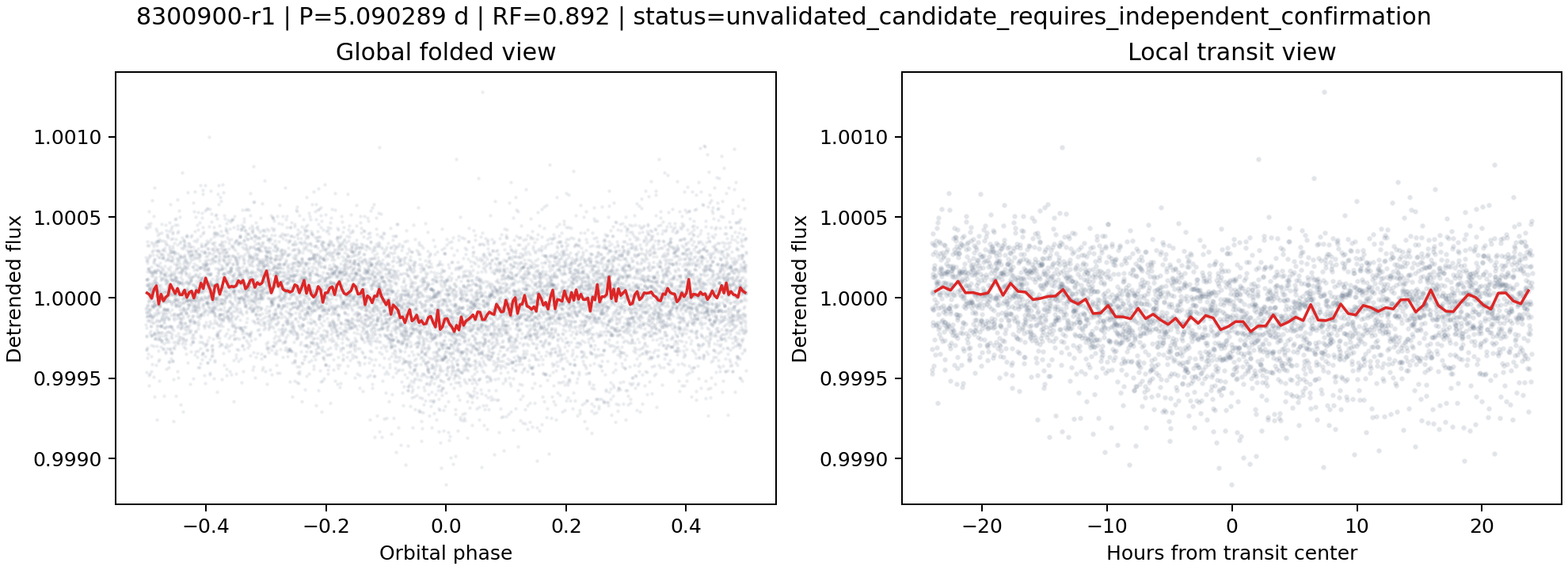
The best FAP belongs to KIC 8300900-r1:
- period: 5.090289 days;
- 19 of 1,000 null maxima equal or exceed observed power;
- plus-one FAP:
20/1,001 = 0.01998; - transit fit: U-shaped;
- physical-size plausibility: pass;
- Gaia evidence: available;
- TESS period support: none; and
- public ExoFOP/TOI record: no matching public record at audit time.
Because FAP is above the 1% strong threshold and TESS support is absent, the
signal is weak_candidate, not a confirmed exoplanet. The second-best FAP is
0.05594, already above the key-failure boundary.
Primary conclusion
SXS demonstrates a complete, auditable computational workflow and records a negative candidate-search result honestly. The scientific contribution is the reproducible recovery, ranking, and independent-vetting methodology—not a new planet claim.